Job openings
Currently, we are offering 1 PhD position. Below we provide a full description of the position. Also, we are often looking for Post-Doc researchers. Are you curious? Drop us a line!
Deadline: July 31st, 2026 – PhD positon (experimental) – Fully funded, four years – FPI Severo Ochoa excellence grant
Vibrational Fingerprints of Energy Dissipation
Friction and adhesion account for close to 30% of global energy losses, yet their microscopic origin remains poorly understood. We can measure that energy is dissipated when a contact moves; we cannot yet say where that energy goes, or how. This PhD sets out to close that gap. You will develop an atomically resolved, real-time measurement of how energy leaves a single-molecule contact, and use it to link for the first time a macroscopic friction coefficient to the vibrational modes that carry the energy away.
The measurement is possible now because integrating light with scanning probes lets us follow vibrational dynamics at an interface as they happen, and because ICMM has recently commissioned the instrument that does it. The experimental programme is led by Dr. Pablo Merino (ESISNA group), whose laboratory integrates optics with scanning probes under ultra-high vacuum and cryogenic conditions. The supporting theory is developed by the NanoTrib group (Dr. J.G. Vilhena), which specialises in non-equilibrium simulation of nanomanipulation and energy dissipation.
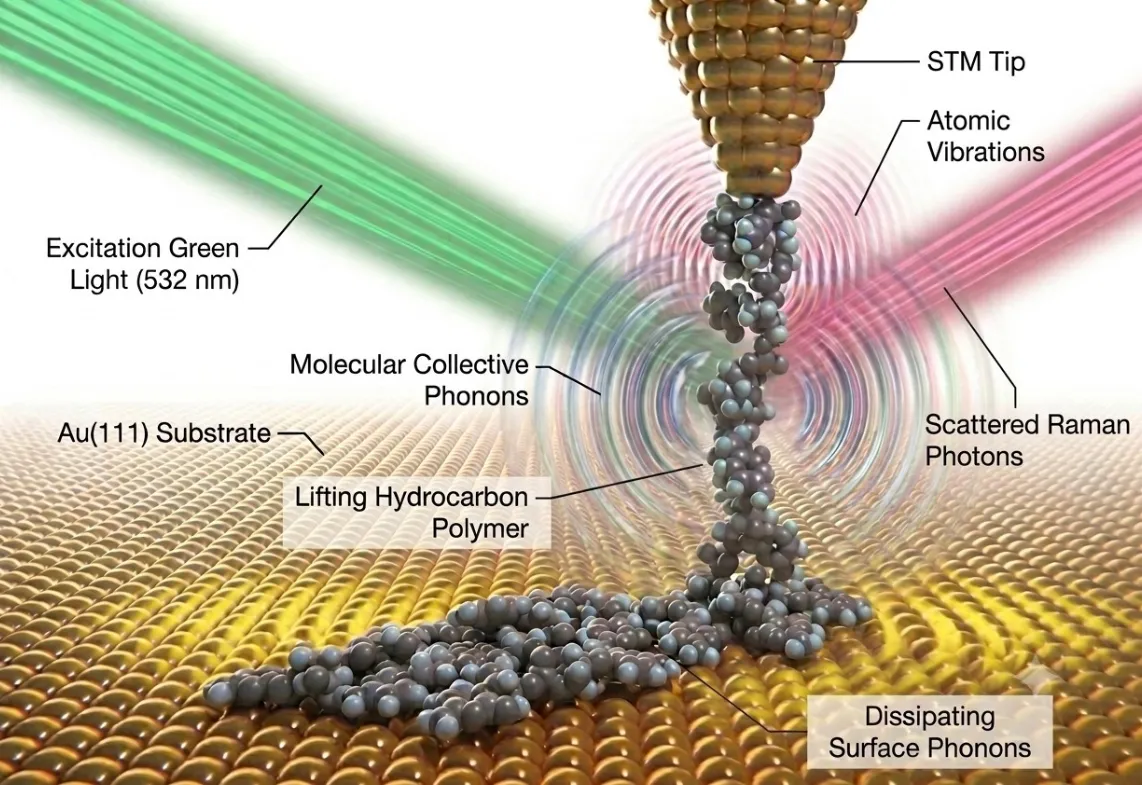
An STM tip lifts a single hydrocarbon polymer from Au(111) while tip-enhanced Raman spectroscopy reads the vibrational modes that carry away the dissipated energy.
Approach
You will test a specific hypothesis: that dissipation is governed by characteristic vibrational fingerprints, modes that act as energy sinks. Identifying them, and understanding how energy transfers into them and then dephases, would connect the friction coefficient to the phonon density of states and to anharmonic interactions. The work follows a three-step, experiment-driven route:
Measure the dissipation
On the newly commissioned cryogenic aperture-less SNOM (operational since June 2025 in the ultralow-vibration Photon-STM lab), you will lift single molecules off inorganic surfaces. A picowatt-sensitive tuning-fork sensor records the energy dissipated during the lift. Sharp peaks in the dissipation channel mark each step of detachment, the moments at which energy is lost.This provides a quantitative, atomically resolved benchmark of dissipation in a single-molecule contact.
Trace the pathway
During those peaks you will perform time-correlated tip-enhanced Raman spectroscopy, reading out in real time which vibrational modes are excited as the molecule detaches. This extends an established group toolbox: Ångstrom-scale TERS imaging of single molecules, picosecond photon-correlation spectroscopy, and time-correlated single-photon counting. The stepdetermines whether energy dissipates directly into the substrate or transfers coherently to molecular vibrations that then dephase.
Control it!
With the fingerprints identified, the aim is to suppress them. By chemically tuning molecules to close specific modes, the project works toward controlling how mechanical energy is dissipated in a nanoscale contact, and toward a route for engineering friction and adhesion at the molecular scale.
Supervision
The thesis is co-supervised by two Principal Investigators, within a single, coherent project. Dr. Pablo Merino (ESISNA, ICMM-CSIC) is the lead supervisor and directs the experimental programme, which forms the core of the thesis. Dr. J.G. Vilhena (NanoTrib) co-supervises providing the theoretical backing tho interprets and supports the measurements. You will meet regularly with both PIs. The experimental training is the centre of the thesis; the theory collaboration gives you the framework to understand what you measure.
Environment and resources
The project runs on a newly commissioned cryogenic aperture-less SNOM, operational since June 2025, in the ultralow-vibration Photon-STM lab. You will also draw on plasmonically active nanopatterned probes from the Nanofabrication-Lab, symbolic-regression tools from the AI-Lab for extracting analytical friction laws from data, and one of ICMM’s largest HPC facilities. The work is supported by the ICMM Severo Ochoa programme.
Training and network
You will join a group with an established record of training researchers to a high international standard. Supervision extends through an international network, including long-standing collaborations with Dr. Martin Švec (Institute of Physics, Czech Academy of Sciences) and Dr. Anna Roslawska (Max Planck Institute, FKF), with funded research stays abroad. Training is completed through the doctoral school, the ASEVA foundation, and international workshops where the groups serve on the scientific committee.
What we offer
– A four-year FPI-Severo Ochoa PhD excellence grant at ICMM-CSIC, in Madrid.
– A gross salary between €25,000 (~1700€/month net) and €27,000 per year, rising each year.
– Co-supervision by an experimental and a theory PI, within one coherent project.
– A newly commissioned cryogenic aperture-less SNOM platform, with in-house nanofabrication, HPC, and AI-driven analysis.
– Funded research stays with international partner groups.
Who we are looking for
A candidate with a degree, completed or near completion, in physics, chemistry, materials science, nanoscience, or a related field. Experimental aptitude and an interest in instrumentation are essential; comfort working between experiment and theory is an advantage. The working language of the group is
English.
How to apply
Send a CV, a short statement of interest, and the names of two referees to both PIs: Pablo Merino (pablo.merino@csic.es) and Guilherme Vilhena (guilherme.vilhena@csic.es).
The position will be filled as soon as a suitable candidate is found, so early applications are encouraged.
